

I’m sure you don’t need me to help you firm up your opinions about Israeli anti-draft protests. You already either love multi-hour traffic jams, noisy and violent clashes, and bitul Torah or you don’t. Nothing I might say here will change that.
What I would like to talk about is the institution of protests: both its evolution and how it fits into Torah and, in particular, halacha.
A Jewish History of Protest
The odds are that early charedi protests from the years between 1948 and around 1980 were consciously modeled on the Gemara in Rosh Hashana 19a:
בעשרים ותמניא ביה אתת בשורתא טבתא ליהודאי דלא יעידון מאורייתא שגזרה המלכות גזרה שלא יעסקו בתורה ושלא ימולו את בניהם ושיחללו שבתות מה עשה יהודה בן שמוע וחביריו הלכו ונטלו עצה ממטרוניתא אחת שכל גדולי רומי מצויין אצלה אמרה להם בואו והפגינו בלילה הלכו והפגינו בלילה אמרו אי שמים לא אחיכם אנחנו ולא בני אב אחד אנחנו ולא בני אם אחת אנחנו מה נשתנינו מכל אומה ולשון שאתם גוזרין עלינו גזירות קשות וביטלום
“On the 28th (of Adar) good news came to the Jews that they wouldn’t be forcibly separated from the Torah. For the monarchy had decreed that they should not engage in Torah or circumcise their sons, and that they should transgress Shabbos. What did Rabbi Yehuda ben Shamua and his friends do? They went for advice to a noble woman who was often visited by all the Roman aristocracy. She said to them: ‘Go and cry out at night.’ They went to cry out at night saying: ‘Where are the heavens? Are we not your brothers, the sons of a single father and a single mother? We should we be different from every other nation and language that you impose such harsh decrees.’ [The decrees] were annulled.”
Facing a harsh decree? Head out to a place where decision makers can hear you and plead your case. Based on the text, there are some limits, however:
There’s no indication that Rabbi Yehuda ben Shamua and his friends were in any way disruptive or violent.
The plan was to use emotional arguments to appeal directly to government leadership as an attempt to evoke their good will.
The arguments were relatively sophisticated and targeted (rather than needlessly provocative “bumper sticker” slogans).
We don’t know how long the protests lasted nor how much longer Rabbi Yehuda ben Shamua would have kept them going before giving up.
I’m sure that R’ Amram Blau was thinking about this Gemara as he planned his Friday night demonstrations outside movie theaters in the early years of the State of Israel. I also understand that R’ Blau considered himself a “disciple” of Gandhi’s non-violent philosophy of civil disobedience. Dr. Martin Luther King was also part of that tradition.
And that’s important. Because you only occupy the moral high ground of civil disobedience when your protests are peaceful and when the protesters are willing to take legal responsibility for their actions. There’s no blanket exemption from the law just because you’re unhappy with something the government’s done.
Arguably, Dr. King’s Letter from Birmingham Jail had a greater impact on the success of his cause than the actual demonstration where he was arrested.
A General History of Protest
The mass-participation demonstration is a relatively modern phenomenon. There have been riots for many centuries, but they were mostly spontaneous, violent, localized, and aimed at overthrowing officials or resisting taxes rather than persuading governments to change policy. In some ways, the American and French Revolutions could be seen as the first mass movements aimed at influencing governments.
Today, protests around the world are so common that there are entire academic institutes devoted to tracking them. What changed? New modes of governance - including legal protections for freedom of assembly and speech - provided the legal and practical space that let it happen.
Consider the consequences of staging a mass demonstration in the Soviet Union or any Eastern European country where the authorities felt free to react with violence. So many young Orthodox Jewish men were drafted into the Russian army that the Chofetz Chaim wrote an entire book (מחנה ישראל) as a guide for them. Yet there’s no record of even a single public protest against the draft. Israel is not Poland.
Modern protests would have been unthinkable. But even if they had been possible in theory, sometimes the costs outweigh the (deeply unlikely) benefits of a victory.
Is Disruptive Protest Democratic?
Absolutely not. The democratic form of protest is voting. Assuming votes are properly counted, the winners get to decide how the country is run. As I’ve written elsewhere, majority rule has a solid foundation in Halachic sources - although it probably never took quite the same forms we’re used to in the 21st century.
Having said that, democracies need to find ways to accommodate minority voices so we don’t fall into a tyranny of the majority. That’s a very difficult balance to achieve. At the same time, in large countries everyone is unhappy about something. Logically - and logistically - it’s not rational to expect everything to go your way.
Regardless of how many people and movements engage in protest in Israel and around the world, a Torah Jew must assess his actions against Torah values. Blackmail - using threats to force someone to unwillingly change his behavior to suit your needs - is an ugly thing. And in many ways, it’s not compatible with halacha.
Blocking public access to roads and buildings is the classic בור ברשות הרבים. As every twelve year old cheder boy knows, anyone who is significantly inconvenienced by the blockage has the right to destroy it and forcibly remove the people associated with it.
Even accidentally damaging private or public property is explicitly forbidden and actionable (אדם מועד לעולם). Those responsible are required to fully reimburse all damages caused by anything from setting fire to buses or overturning police cars to damaging municipal crowd control barriers. (Until you do, good luck with this coming Rosh Hashana.)
Preventing ambulances and first responders from doing their work is pretty much synonymous with murder.
Intentionally causing traffic congestion is - effectively - kidnapping (לא תגנוב - see Rashi to Shemos 20:13). After all, kidnapping involves forcing someone to be somewhere he doesn’t want to be. No one wants to sit in traffic. While I doubt any bais din would ever prosecute based on such logic, between God and man (לצאת ידי שמים), how would this not be a problem?
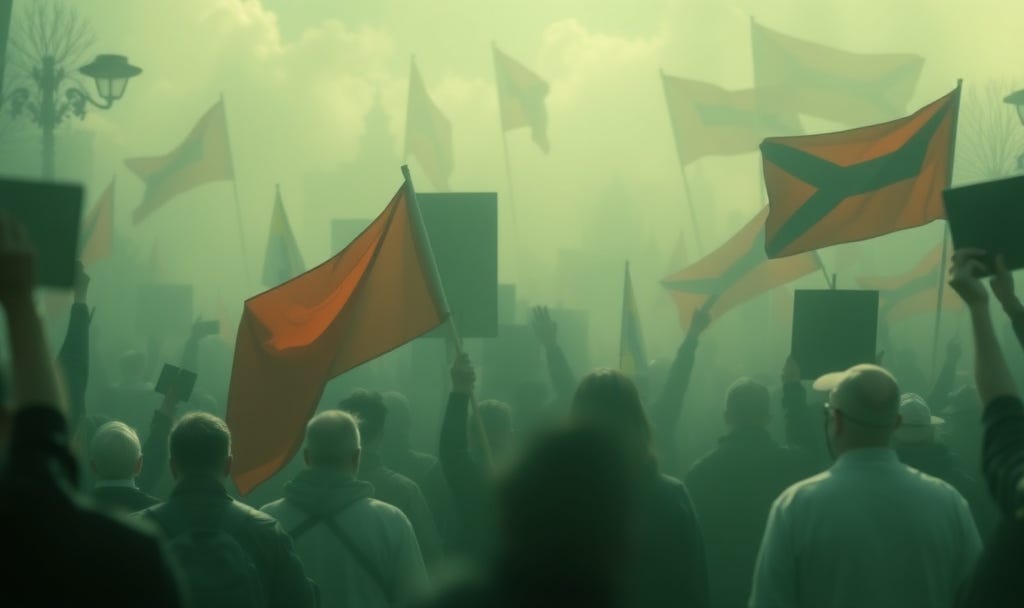
Over the past few years, the nature of protests has changed yet again. It’s often no longer about using persuasion to change minds by appealing directly to voters or governments. I can’t picture anyone experiencing a charedi riot and being attracted to the beauty of God’s Torah.
Instead, more often than not, it’s about the exercise of raw power. The not-so-subtle message delivered by tens of thousands of people shutting down movement through a busy city is: “Give us what we want or we’ll destroy everything.” Or in other words, blackmail. Ugly blackmail.
Do Mass Gatherings Actually Help?

A lot has been said about whether or not “yeshivishe” people should have attended Tuesday’s March for Israel rally in Washington. I don’t have anything interesting to add to that conversation. But I haven’t seen anyone addressing a different point that might be even more important: is there any
Halacha and War
A powerful video from an Israeli rosh yeshiva, Rabbi Tamir Granot, has recently attracted a lot of attention. Besides losing his own son in the fighting, R’ Granot is convinced that there’s no halachic or moral excuse for a Torah-loyal Jew to avoid participating in the current war.
The Economics of the Modern Tzedaka Industry

This article is a re-post from some months ago. But most of you probably haven’t yet seen it. And the issues covered here haven’t exactly disappeared in the meantime.
Excellent piece. The following emotional rant won't make me popular, but here goes...those protests are a giant chillul Hashem. They look terrible. The message is one of extreme entitlement, and reaffirms the ugly stereotype that Jews have no loyalty to whichever country in which we live, leading goyim to conclude that's the reason no one likes us. We're now giving those haters the ultimate validation to that narrative, that we can't even show loyalty when given our own country. We will take take take from the country, by receiving state benefits (healthcare, infrastructure, security, and stipends) all of which implies a reciprocal obligation to defend that state. Instead, we selfishly refuse to share in that burden of fighting with those from which we take. It's actually disgusting behavior, inexcusable, and indefensible.
I say the same thing in any country, whether it's the US or Canada, if you refuse to fight for it, leave. We aren't in Soviet Union. You're free to go live in other countries that share your values and won't force you to fight for them. You can continue to pretend we're still living under the Czar, where we did our own thing and never fought for the Czar. In other words, you can continue to run your little game of take take take while refusing to fight for the very same country that provides you the right to take take take. Until you leave, stop kvetching and shut up. You sound like a spoiled whiney little girl.
I'm not saying every Jew must enlist in a military, but when your country faces existential crisis, and your neighbors risk their lives to save you, and they ask you to join, it's a chutzpah to say "no, I'm good. I got my gemarah, I'll sit it out." Really? ״האחיכם יבאו למלחמה ואתם תשבו פה?״
(Bamidbar 32:6). I don't care if your complex Talmudic gymnastics can dismiss that warning. You may convince yourselves that you are David HaMelech winning the war by shtieging away, but that's not at all how it looks when hundreds of thousands of little King Davids refuse to serve.
Look, if you refuse to fight, instead of making a giant chilul Hashem in the streets, find your manhood, move to the US, and learn all the Torah you wish. Ah, you can't move to the US because its government won't pay you to sit in kollel all day? Kal v'chomer! Entitlement x2000!
just today i read they attacked the light-rail construction in Jerusalem. i heard they basically gave on that whole line because of repeated attacks.
I've always been a proponent of exempting שבט לוי from army service which might be close to Eisenkot 3% exemption. actually i dont believe in any forced induction but thats a different story